We now have added "Informational Posts" which are tidbits of information that may come in handy at some point.
Showing posts with label Sex Offender Policy. Show all posts

The Failure of Sex Offender Policy

6-4-15 National:

The public expects and deserves evidence-based practices when it comes to public safety. This is true for any aspect of public policy but perhaps none so much as sex offender policy. With sex offenders, there is a sense of moral outrage at the depravity of their crimes, and rightly so. Virtually any sex crime makes the news headlines because the public has a very high interest in this crime. Too often politicians not only capitalize on the fear that is caused by sex offenders, but they inadvertently create more of it.

The manner in which this happens can be seen in sex offender registries and residence restrictions. Using the law to require that someone has to register to be on a registery, politicians are effectively saying that the person who previously offended is someone you need to be afraid of for future re-offending, even though the research says the likelihood is the lowest of the crime categories. Or by requiring through law that sex offenders cannot live in certain places, politicians are saying that if the converse were true, children would not be safe, even though place of residence has virtually nothing to do with who will be victimized.

Why Do Politicians Use Fear?

Sometimes they may do it on purpose to boost their popularity in being proactive on important issues. But I think the main reason is that politicians are regular people who got elected but who are not experts in this field and they just don't know what they don't know. Crime policy and the science of correcting criminal behavior is very complicated. We tend to think that what would deter us (the non-criminal population) from committing a crime is the same thing that would deter them (the criminal population) from committing a crime. This is incorrect thinking.

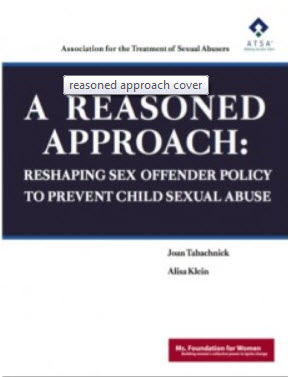
A REASONED APPROACH: RESHAPING SEX OFFENDER POLICY TO PREVENT CHILD SEXUAL ABUSE

April 2011:

Executive Summary:
It is only in the last 30 years that society has begun to fully recognize child sexual abuse as the devastating problem that it is, to portray the trauma of sexual abuse in the media, and to seek ways to prevent and eliminate sexual violence. As communities have begun to demand a response to sexual abuse, legislators have passed an increasing number of policies directed at the people who sexually abuse. In 2007 and 2008 alone, more than 1500 sex offender-related bills were proposed in state legislatures and over 275 new laws were enacted.

Nearly all of these laws and policies follow two key trends: 1) they increase the length of sex offender incarceration and 2) they monitor, track, and restrict individuals convicted of sexual offenses upon their return to communities.

While the intent of these laws is to protect communities from those who abuse, to improve responses to allegations of abuse, and to prevent child sexual abuse, the broad application of these laws has unintended consequences which may make our children and communities less safe. Research from the last decade has highlighted some of the unintended negative impacts these laws may be having on our ability to prevent sexual abuse before it is perpetrated and to prevent re-offense by individuals returning to communities:
■ Since those who abuse are often portrayed publicly as “monsters,” people may be less likely to recognize the warning signs of sexual behavior problems in siblings, parents, children, cousins, or others to whom they are close because they do not see them as “monsters.”

■ Someone who suspects abuse within the family may be less likely to seek resources and assistance, fearing that it will result in the public exposure and humiliation of everyone involved, including the victim.

■ When a convicted abuser returns to a community, current sex offender management policy may cause the offender to face housing, employment, and financial instability, as well as social isolation and despair — all risk factors for re-offense. The resulting instability may also reduce the ability of law enforcement and probation and parole systems to supervise the offender and ensure that s/he has access to the specialized treatment and services necessary for full accountability.
In creating a legislative policy environment that may inhibit the willingness of individuals, families, and communities to face, prevent, and respond to child sexual abuse, our society does a disservice to its children. If no hopeful, rehabilitative solutions are available and made publicly known, people who witness signs of risk for victimization and/or perpetration may be less motivated to take the steps necessary to prevent child sexual abuse, intervene in situations of risk, and come forward when a child is sexually abused. Experts agree that a criminal justice response alone cannot prevent sexual abuse or keep communities safe. Yet, tougher sentencing and increased monitoring of sex offenders are fully funded in many states, while victim services and prevention programs are woefully underfunded. Furthermore, with the majority of child sexual abuse unreported (report rates are as low as 12 percent), laws and policies are unable to ensure accountability for those who abuse or to address the needs of victims. Even with these concerns there is reason for hope.

For the remainder of this paper: by Joan Tabachnick and Alisa Klein, of ATSA

The War on Sex Offenders: Community Notification in Perspective

November 2000:

Abstract
This article explores the contemporary phenomenon of ‘naming and shaming’ sex offenders. Community notification laws, popularly known as Megan’s Law, which authorise the public disclosure of the identity of convicted sex offenders to the community in which they live, were enacted throughout the United States in the 1990s. A public campaign to introduce ‘Sarah’s Law’ has recently been launched in Britain, following the death of eight-year old Sarah Payne. Why are sex offenders, and certain categories of sex offenders, singled out as targets of community notification laws? What explains historical variability in the form that sex offender laws take? We address these questions by reviewing the sexual psychopath laws enacted in the United States in the 1930s and 40s and the sexual predator and community notification laws of the 1990s, comparing recent developments in the United States with those in Britain, Canada, and Australia. We consider arguments by Garland, O'Malley, Pratt, and others on how community notification, and the control of sex offenders more generally, can be explained; and we speculate on the likelihood that Australia will adopt community notification laws.

For the remainder of this paper: by Lyn Hinds -and- Kathleen Daly

Myths and Facts about sex offenders: Implications for practice and public policy

2007

Abstract
Aim: The purpose of this study was to determine to what extent perceptions about sexual offenders are based on empirical evidence or misconceptions.

Background: Sexual offenders have often been under the spotlight of media attention and public censure. Legislatures in the United States and abroad have passed increasingly restrictive and intrusive laws in order to protect the public from convicted sexual offenders. Sex offender policies are often passed hastily and are not based on scientific evidence but on emotional reactions to high profile, violent, disturbing cases.

Method: Data were collected in Brevard County, Florida from 192 community members and 125 sexual offenders in outpatient treatment, all of whom were surveyed regarding their knowledge about five common themes. Comparisons between groups were analyzed, as were comparisons between participants’ responses and published data.

Results: Results revealed that both sex offenders and the public overestimated the rate by which strangers victimize children, and overestimated the number of sex offenders who were victims of sexual abuse in childhood. Both offenders and the public overestimated the number of sex crimes that come to the attention of authorities. The public more extensively than offenders overestimated the frequency of sexual recidivism rates and underestimated the efficacy of sexual offender treatment in comparison to the literature.

Conclusions: Common misconceptions may interfere with offenders’ treatment and reintegration into society as well as influence legislatures to pass laws that are misguided and inefficient. Implications for policy and practice are discussed. ..more.. by Timothy Fortney, Jill Levenson, Yolanda Brannon & Juanita N. Baker

Fortney, T., Levenson, J.S., Brannon, Y., & Baker, J. (2007). Myths and Facts about sex offenders: Implications for practice and public policy. Sex Offender Treatment 2(1), 1-17.

THE PURSUIT OF SAFETY: Sex Offender Policy in the United States

September 2008:

Tracy Velázquez. The Pursuit of Safety: Sex Offender Policy in the United States. New York: Vera Institute of Justice, 2008.

Executive Summary
Local, state, and federal policymakers have paid ever more attention to sex offenses over the past 20 years. In the wake of several high profile crimes by strangers against children in particular, they have crafted a growing body of legislation intended to protect the public from sexual predators. This legislation has expanded the scope of crimes that qualify as sex offenses, over the past decade more than doubled the number of people required to register as sex offenders, increased sentences for people found guilty of sex offenses, and established strategies designed to manage convicted sex offenders after their incarceration. Examples of these latter strategies include registration, community notification requirements, residency restrictions, electronic monitoring, and civil commitment.

The proliferation of these responses has generated little consensus about which available strategies are most effective. Consequently, many policymakers concerned about using public funds to maximize outcomes (consistent with the principles of fairness and justice) understandably are confused about their options for deterring would-be offenders, reducing recidivism, and incapacitating the most dangerous offenders. With support from the Bureau of Justice Assistance (part of the U.S. Department of Justice, Office of Justice Programs), the Center on Sentencing and Corrections at the Vera Institute of Justice conducted a nationwide review of current sex offender laws, policies, and trends. This report represents the results of that systemic analysis.

Analysis reveals that the public supports current national legislative focus on responding to sex offenses and presume that these responses have contributed to the drop in sex offenses that has been recorded in recent years. However, it is unclear whether any of these measures have had a significant impact on sex offense rates. In large part, this is because most policies are aimed at predation by strangers, whereas sex offenses are more often committed by family members and acquaintances. In addition, a concurrent overall decrease in violent crime makes it difficult to identify the influence of the sex offender legislation on reductions in sexual offending. And several policies—particularly residency restrictions and community notification—may have negative impacts on public safety due to the impediments they create to successful reintegration of offenders who have completed their sanctions. Registration itself appears to somewhat reduce recidivism, but not for offenses against strangers. Electronic monitoring has shown some positive outcomes in some jurisdictions while having little impact in others, particularly those where it has been recently implemented. And while effective at incapacitating offenders, civil confinement is four times as expensive as incarceration and to date has not been particularly successful at treating offenders.

Finally, it appears that the public opinion that often drives policy in the sex offender realm is based on the belief that sex offenders are dangerous strangers who are apt to victimize children and re-offend. In reality, however, most sex offenders don’t re-offend, and the definition of a sex offender is broad and encompasses different types of offenses, some more severe than others. Moreover, children are more at risk of being sexually victimized by a family member or other person known to them than they are by a stranger living a block away from their home or school.

For the remainder of this study: by Tracy Velázquez, Vera Institute of Justice

Controlling Sex Offender Reentry - Jessica's Law Measures in California

2006 (California Reentry Study):

This is an in-depth analysis of Prop-83 in California and what it was based on, much of which is beliefs of one lawmaker, Senator George Runner and his wife Assemblywoman Sharon Runner. These folks spearheaded the Sexual Predator Punishment and Control Act which was based on many false beliefs. The study focuses on the renentry of sex offenders into communites.

Unfortunately this study is such that it cannot be copied -even portions- hence this short paragraph about it.

For the remainder of the study by Jason Peckenpaugh

THE INFLUENCE OF SEX OFFENDER REGISTRATION AND NOTIFICATION LAWS IN THE UNITED STATES

2001 (SO Policy):

Abstract:
This paper explores the impact of sex offender policies by examining sex offenses through time series analysis. Using monthly count data of rapes aggregated at the state level, this analysis uses Box-Jenkins autoregressive integrated moving average (ARIMA) models to conduct ten separate intervention analyses on the enforcement of Megan’s Law. The results of the interrupted time series analyses are mixed with regard to whether the enforcement of sex offender registration had a statistically significant effect on the number of rapes reported at the state level. Although several states showed a nonsignificant increase in the number of rapes, only three states had a significant effect on decreasing the number of rapes. Policy implications of this research are discussed in terms of the efficacy of sex offender registration and whether changes in these laws should be considered.


SEE STUDY....


DISCUSSION AND CONCLUSIONS
Sex offender registration and notification policies are a relatively recent development in the criminal justice system. As such, there has been neither a great deal of methodological development nor many empirical findings. This research has attempted to overcome this lack of research by empirically exploring the effect of sex offender registration and notification laws on the number of sex offenses, measured by rape, committed over time across the United States. Utilizing time series analysis (ARIMA), we examined the incidence of rape in a sample of 10 states to see if the sex offender laws had any noticeable influence on sex offenses.

The key finding of this research is that the passage of sex offender registration and notification laws have had no systematic influence on the number of rapes committed in these states as a whole. Most of the states in our sample (five of ten) showed no significant differences (increase or decrease) in the average number of rapes committed before and after the sex offender laws. These non-significant findings masked the fact that roughly half of these non-significant changes were actually increases in the average incidence of rape within a given state. Of the states (four of the ten states) that did indicate statistically significant findings, three of these states experienced a decrease in the number of rapes after the implementation of the laws. The fourth state, however, actually illustrated a steep, statistically significant increase in the number of rapes committed.

These findings beg the question of what is occurring concerning the relationship between sex offender registration and notification and subsequent sex offending. It is possible, as Sample’s (2001) research indicated, that this was knee jerk legis lation based simply on keeping the constituency happy. If that is true, sex offender registration and notification laws are failed legislation. As discussed above, there are alternative explanations of what could be occurring. These include a deterrent nature to these laws, a heightening of police awareness, both, or the rape counts simply decreased at the same time as the introduction of the law and therefore our model could be misspecified (i.e. confounded). We offer several suggestions of how these differing explanations may be producing the findings of this research.

First, sex offender registration and notification laws are based on the assumption that sex offenders are more likely to recidivate than other offenders. The research on the validity of this assertion is very mixed. While the nature of our data does not permit us to comment one way or the other in this area, sex offenders are assumed to be an identified group. As such, the rationale behind sex offender laws would assume that a majority of the offenses committed within the confines of any year would actually be sex offenders who are re-offending. A potential alternative assumption is that in those states with increases (roughly half of the states examined here), it would be expected that these offenders would be first time offenders or offenders who have never been caught before. This is supported by Walker and McLarty (2000) who found that 73% of sex offenders in their study committed a sex offense as their first offense. If this is the case, it would be
expected that sex offender registration and notification is not able to control this population because a substantial number of them are committing sex offenses as their first offense. Hence, there is no name on the register and no way to inform the community.

Second, these laws may be having no influence on the number of sex offenses because communities are not actively using sex offender registries to protect their communities to the fullest extent possible. Community members may be desensitized to different notification strategies. For instance, Walker et al.’s (2001) research showed that in many cases in Little Rock, Arkansas, registered sex offenders in a majority of cases seemed to choose homes that clustered tightly around day cares, schools, and parks. This means that a potential exists for a motivated [sex] offender to come into contact with a suitable victim (children, in this instance) where there is a lack of some suitable guardian (teachers or parents) according to Cohen and Felson’s (1979) work on the routine activities perspective. The significance of this finding is that the community is apparently doing nothing about these offenders.

Finally, increases in the average number of sex offenses may reflect an increased scrutiny from both communities and the police who are continually updated on the presence of sex offenders. Since there is an increase in the average number of sex offenses in half of the states examined here, police practices, in concert with community support, may now be focusing on more sex offenders. This would lead to an increase in the average number of sex offenses since law enforcement effort is now focused on a predetermined population that is relatively easy to find.

Based on the findings of this study and the potential conflicting explanations, future research on sex offender registration and notification policies should explore several different paths. First, a more appropriate unit of analysis would be the city. Cities may be preferable because aggregate level time series data suffers greatly due to binning. As such, using smaller “bins,” such as cities, might give more insight than using state level data, which loses detail in comparison. Second, because, sex offender registration is mainly addressing repeat offenders, future research should focus on sex offender recidivism before and after the enforcement of sex offender laws. Finally, future research should address sample size. While we intended to conduct time series analysis on all 50 states, after getting data from states with adequate follow- up time and excluding state data that did not conform to time series analysis, our final sample was only 10 states. Data mining techniques are constantly improving, and the follow-up periods in states now allow for at least a three year follow- up. Future time series research on sex offender policies should also explore these states.

For remainder see study by Jeffery T. Walker, PhD, University of Arkansas at Little Rock and Sean Maddan, Statistical Systems, Inc. and Bob E. Vásquez, University of Albany, SUNY and Amy C. VanHouten, Statistical Systems, Inc. and Gwen Ervin-McLarty, Director Statistical Analysis Center Arkansas Crime Information Center


Note: Chart showing when registries were implmented.