We now have added "Informational Posts" which are tidbits of information that may come in handy at some point.
Showing posts with label ~ATSA. Show all posts

Assessment, Treatment, and Supervision of Individuals with Intellectual Disabilities and Problematic Sexual Behaviors

March 2015:

EXECUTIVE SUMMARY
Professionals providing treatment, supervision, and management to adult persons who have sexually offended recognize the unique needs of those individuals who have concomitant intellectual disabilities and problematic sexual behaviors (IDPSB).

Problematic sexual behaviors are defined in this context as sexually offensive conduct that places either the client or others at risk for harm or social prejudice. The prevalence of persons with IDPSB varies between studies, but the results suggest that persons with IDPSB are over-represented in the criminal justice system.

As a result, many practitioners providing assessment and treatment services to adults who have committed sexual offenses will at some point encounter persons with IDPSB. In this document, the following areas related to persons with IDPSB are explored:
•Standardized assessment
•Promising and effective treatment interventions
•Specialized supervision consideration

..Continued.. by ATSA

ATSA Policy

2014:

Sexual abuse is a public health issue that impacts everyone – individuals, communities, institutions, and society as a whole. The prevention of sexual abuse requires a well-planned, comprehensive, interdisciplinary and evidence based approach. Sexual offense specific strategies and policies should prevent sexual abuse and support the rehabilitation of perpetrators as this will promote long-term community safety.

ATSA is comprised of multi-disciplinary professionals such as psychologists, therapists, researchers, social workers, police officers, parole/probation officers, victim advocates, and lawyers. The ATSA Public Policy Committee’s focus is to provide information and guidance on best practice standards related to the management and treatment of individuals who have sexually abused or are at risk to abuse. This is accomplished by identifying, monitoring, and responding to trends, issues, and concerns related to the management, treatment, laws, and policies for individuals who have sexually abused or are at risk to abuse. Given the devastating impact of sexual abuse, strategies must be informed by research, evaluation, and best practices to strengthen public safety.

Interested in learning more? The information below describes evidence based strategies that lead to the effective assessment, treatment and management of individuals who have sexually abused or are at risk to abuse. The ATSA Public Policy Committee works diligently to stay current on policy changes and update this site accordingly. However, policy changes often occur rapidly, so there can be a lag time for updates. If you think a document is out of date, please contact us.

To access information, click on the category of interest for links to downloadable position papers, fact sheets, and other information related to each topic area. ..Continued.. by ATSA

Civil Commitment of Sexually Violent Persons

August 2010:

History: States w/CC are omitted here. This follows:

Typically, these laws provide a legal mechanism for the confinement of a limited number of ADULT sexual offenders in a secure treatment after incarceration when a court determines they are likely to engage in future acts of sexual violence.

Texas has an exclusively community-based commitment program and Pennsylvania has a civil commitment program only for juvenile offenders aging out of the delinquency system.

To meet the criteria for commitment, the offender must suffer from a mental abnormality or personality disorder predisposing the offender to commit future acts of sexual violence.

The use of civil commitment for sexual offenders has generated considerable debate in legal and clinical professions, and it continues to be debated even among professionals who work with and conduct research on sexual offenders.

Proponents argue that such provisions offer an important community protection safeguard by incapacitating a high risk subgroup off sex offenders. In addition, civil commitment can provide opportunities for these individuals to receive treatment interventions that may reduce their potential to recidiviate upon release to the community, particularly offenders for whom specialized treatment was not available in the prison setting.

Objections to civil commitment are generally three fold.

First, the legal mechanism by which the offenders are detained when civill committed depends on clinical criteria primarily created or defined by legislative bodies rather than by the scientific or mental health communities. ..Continued.. by ATSA

The Registration and Community Notification of ADULT Sex offenders

April 2010:

This post brings in another of ATSA's Policy Statements.

..Continued.. by ATSA

Sex Offender Residence Restrictions

August 2014:

A new Policy Statement by ATSA

ATSA supports evidence based public policy and practice.. Research consistently shows that residence restrictions do not reduce sexual reoffending or increase community safety.

In fact, these laws often create more problems than they solve, including homelessness, transience, and clustering of disproportionate numbers of offenders in areas outside of the restricted zones.

Housing instability can exacerbate risk factors for reoffending. Therefore, in the absence of evidence that these laws accomplish the goals of child protection, ATSA does not support the use of residence restrictions as a feasible strategy for sex offender management. ..Continued.. by ATSA

8 Things Everyone Should Know About Sexual Abuse & Sexual Offenders

June 2014:

Sexual abuse is a pervasive yet preventable worldwide problem that impacts everyone - individuals, communities, institutions, and society as a whole.

Education is essential in the prevention of sexual abuse, but educational efforts are often impaired by the numerous myths and misconceptions that abound about sexual abuse and those who perpetrate sexual abuse.

The questions and answers below are designed to provide up to date information about sexual abuse and those who perpetrate sexually abusive behaviors.

1. What is sexual abuse?
Sexual abuse is a broad term ...continued...
...

Civil Commitment of Sexually Violent Predators

ATSA Position Paper:

Adopted by the ATSA Executive Board of Directors on August 17, 2010

History

Twenty states (Arizona, California, Florida, Illinois, Iowa, Kansas, Massachusetts, Minnesota, Missouri, Nebraska, New Hampshire, New Jersey, New York, North Dakota, Pennsylvania, South Carolina, Texas, Virginia, Washington, and Wisconsin) and the District of Columbia have enacted laws permitting the civil commitment of sexual offenders. In addition, the Adam Walsh Child Protection and Safety Act of 2006 authorized the federal government to institute a civil commitment program for federal sex offenders (42 USC 16971). Typically, these laws provide a legal mechanism for the confinement of a limited number of adult sexual offenders in a secure treatment facility after incarceration when a court determines they are likely to engage in future acts of sexual violence. Texas has an exclusively community-based commitment program and Pennsylvania has a civil commitment program only for juvenile offenders aging out of the delinquency system. To meet the criteria for commitment, the offender must suffer from a mental abnormality or personality disorder predisposing the offender to commit future acts of sexual violence.

The use of civil commitment for sexual offenders has generated considerable debate in legal and clinical professions, and it continues to be debated even among professionals who work with and conduct research on sexual offenders.

Proponents argue that such provisions offer an important community protection safeguard by incapacitating a high risk subgroup of sex offenders. In addition, civil commitment can provide opportunities for these individuals to receive treatment interventions that may reduce their potential to recidivate upon release to the community, particularly offenders for whom specialized treatment was not available in the prison setting.

Objections to civil commitment are generally threefold. First, the legal mechanism by which the offenders are detained when civilly committed depends on clinical criteria primarily created or defined by legislative bodies rather than by the scientific or mental health communities. Second, there is concern about the legitimacy of detaining someone as a mentally ill person when there is some doubt about the accessibility of effective treatment. And third, questions exist about the potential diversion of mental health resources away from individuals diagnosed with severe, persistent, and debilitating mental health difficulties in order to serve a limited population of sexual predators who tend not to have such diagnoses and for whom the use of correctional resources may be more prudent. ..Continued.. by ATSA

Adult Male Sex Offender Risk Assessment Selected Bibliography

November 2012:

Note: This bibliography is not intended to be an exhaustive review of the area, but rather a list of research articles and books that focus on many of the various aspects of risk assessment. ..Source.. by ATSA

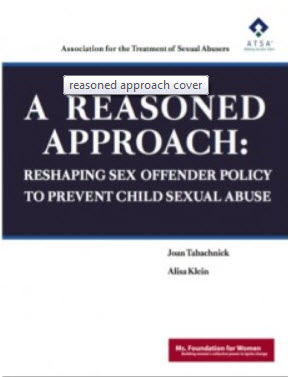
A REASONED APPROACH: RESHAPING SEX OFFENDER POLICY TO PREVENT CHILD SEXUAL ABUSE

April 2011:

Executive Summary:
It is only in the last 30 years that society has begun to fully recognize child sexual abuse as the devastating problem that it is, to portray the trauma of sexual abuse in the media, and to seek ways to prevent and eliminate sexual violence. As communities have begun to demand a response to sexual abuse, legislators have passed an increasing number of policies directed at the people who sexually abuse. In 2007 and 2008 alone, more than 1500 sex offender-related bills were proposed in state legislatures and over 275 new laws were enacted.

Nearly all of these laws and policies follow two key trends: 1) they increase the length of sex offender incarceration and 2) they monitor, track, and restrict individuals convicted of sexual offenses upon their return to communities.

While the intent of these laws is to protect communities from those who abuse, to improve responses to allegations of abuse, and to prevent child sexual abuse, the broad application of these laws has unintended consequences which may make our children and communities less safe. Research from the last decade has highlighted some of the unintended negative impacts these laws may be having on our ability to prevent sexual abuse before it is perpetrated and to prevent re-offense by individuals returning to communities:
■ Since those who abuse are often portrayed publicly as “monsters,” people may be less likely to recognize the warning signs of sexual behavior problems in siblings, parents, children, cousins, or others to whom they are close because they do not see them as “monsters.”

■ Someone who suspects abuse within the family may be less likely to seek resources and assistance, fearing that it will result in the public exposure and humiliation of everyone involved, including the victim.

■ When a convicted abuser returns to a community, current sex offender management policy may cause the offender to face housing, employment, and financial instability, as well as social isolation and despair — all risk factors for re-offense. The resulting instability may also reduce the ability of law enforcement and probation and parole systems to supervise the offender and ensure that s/he has access to the specialized treatment and services necessary for full accountability.
In creating a legislative policy environment that may inhibit the willingness of individuals, families, and communities to face, prevent, and respond to child sexual abuse, our society does a disservice to its children. If no hopeful, rehabilitative solutions are available and made publicly known, people who witness signs of risk for victimization and/or perpetration may be less motivated to take the steps necessary to prevent child sexual abuse, intervene in situations of risk, and come forward when a child is sexually abused. Experts agree that a criminal justice response alone cannot prevent sexual abuse or keep communities safe. Yet, tougher sentencing and increased monitoring of sex offenders are fully funded in many states, while victim services and prevention programs are woefully underfunded. Furthermore, with the majority of child sexual abuse unreported (report rates are as low as 12 percent), laws and policies are unable to ensure accountability for those who abuse or to address the needs of victims. Even with these concerns there is reason for hope.

For the remainder of this paper: by Joan Tabachnick and Alisa Klein, of ATSA